


At Baylor, research & teaching go hand in hand — benefitting BU students
It’s no surprise that Baylor faculty are leaders in their fields. From prestigious national fellowships to coveted grants, Baylor professors are highly decorated for their research and scholarship. One thing that makes Baylor different: Those same researchers can also regularly be found in the classroom, teaching undergraduate students.
At Baylor, research and teaching go hand-in-hand. (That’s why Baylor regularly appears on the short lists of universities with the best undergraduate research and teaching.) That combination provides Baylor undergraduate students with the chance to study under and know professors who are actively impacting their disciplines.
Why is that important to these professors? Three of Baylor’s many award-winning faculty members explain:
Dr. Hope Koch, Baylor’s Godfrey Sullivan Professor of Information Systems and Business Analytics, has earned numerous “best of” awards for significant research journal articles, and received a 2025 AIS Leadership Team Recognition Award from the Association for Information Systems. She has taught an undergraduate Management of Information Systems class since she arrived at Baylor in 2003.
“The highest calling for me is teaching and working alongside students,” explains Koch. “Teaching is where I get to change lives and contribute most to Baylor’s mission of ‘educating men and women for worldwide service.’ My main goal with all my teaching is to equip students with skills so they can secure great jobs. I like undergraduate teaching because I have larger classes and get to touch more lives.
“For my students, my research keeps me connected to what is going on in practice. I teach, research and do service in the field of technology. Through my research, I see how quickly technology and business are changing, which helps me keep my classes practical and relevant.”
Dr. Lorin Matthews, a professor of physics and astronomy, is also associate director of Baylor’s Center for Astrophysics, Space Physics and Engineering Research and recipient of a prestigious American Physical Society Fellowship. She teaches introductory physics courses and a new student experience course to undergrads:
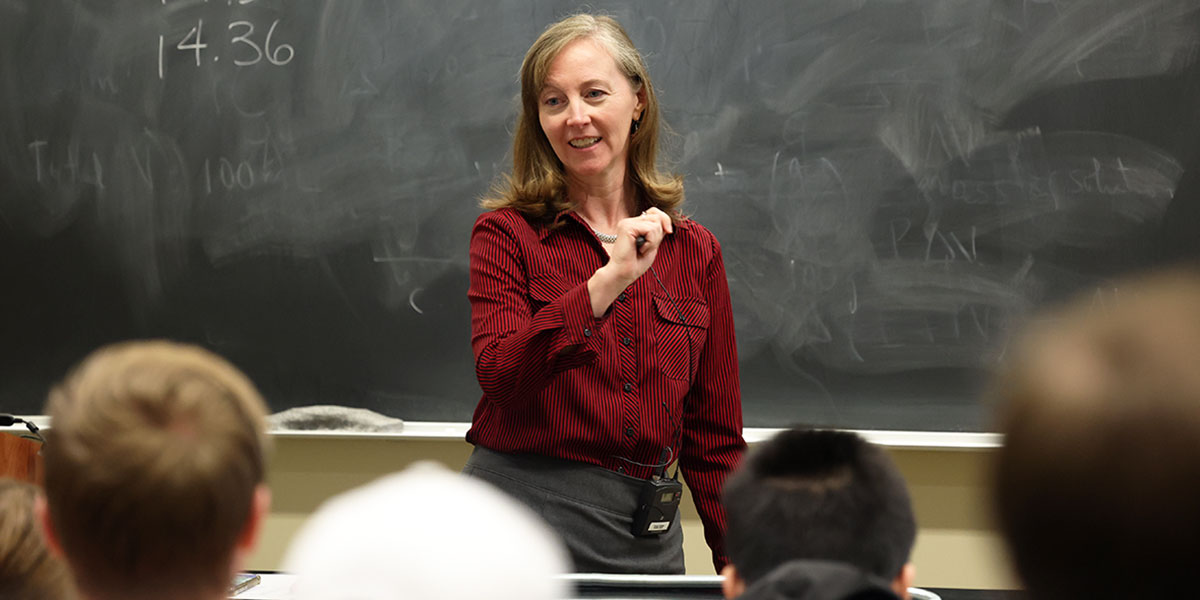
“I love interacting with students. I learn something new from my students each time I teach a class — a new approach to solving a problem, or a new way to think about a concept,” says Matthews (pictured above). “I get to collect all of these nuggets of information and pass them along to the next generation of students. Best of all, I get to identify the students that I think would do well in my research area and invite them to work with me.
“I can use my research in the classroom to provide concrete examples of why we are learning a particular concept. For example, the students in the honors section of introductory physics learn to solve physics problems using computer simulations. This is exactly what I do in my research, just on a bigger scale.”
Dr. Michael Scullin is a nationally recognized sleep researcher who was named a “Rising Star” by the Association for Psychological Science as a young Baylor professor in 2017. His recent TED Talk earned TEDx Editor’s Pick recognition — an honor reserved for less than 1% of all TEDx talks (a speech, incidentally, on utilizing research to teach undergraduate students). He teaches introductory neuroscience courses at Baylor, as well as sleep and cognition classes.
“I can understand why some lab directors would feel torn between their research and teaching, but that’s not my perspective,” says Scullin. “I love teaching. Teaching is an opportunity to see the impact of the lab-based work that the scientists in my field do. Every class meeting, I get to see students’ eyes light up as they learn something that is impactful to their lives. I also enjoy fostering students’ communication skills, courage, locus of control, and data interpretation abilities.
“I also bring my latest research into the classroom. It’s great for the students to learn about brand new research and to have the opportunity to act like a professional scientist for an hour. It’s also great for the lab, because Baylor undergraduates are quite clever and we’ll often hear ideas that we hadn’t yet considered.”
These are just three of the many examples one could find across Baylor’s campus. Their insights make it clear: Research, scholarship and teaching are not separate lanes at Baylor, but integrated aspects of the university’s mission that prepare students to lead and solve problems long after they graduate.
Sic ’em, Baylor teachers!