


Baylor chemistry prof (and alum) earns elite research award
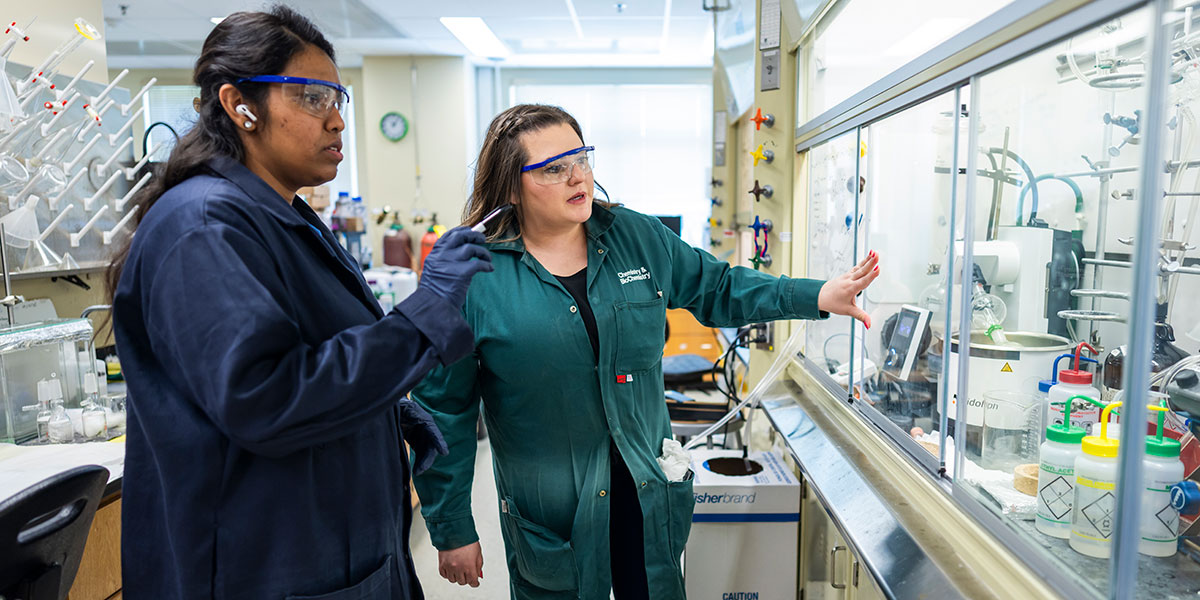
Long before she was recognized for her work in Baylor’s Department of Chemistry and Biochemistry, Dr. Liela Romero (BS ’11) was a Baylor student, much like the ones she now teaches. As she worked in Dr. Kevin Pinney’s lab, she gained the experience she needed to launch her career — from Baylor, to UT Southwestern Medical Center and MIT, and now back at her alma mater.
It’s the same sort of experience she now seeks to impart in her own students, as they combine molecule mixtures that could someday produce cancer drug leads.
“I really didn’t know what organic chemistry research entailed until meeting Dr. Pinney and working in his lab,” says Romero. “I knew from the time I was in seventh or eighth grade that I wanted to have some component of cancer research in my career. I came away from my undergraduate research experience with a love of synthetic chemistry and an interest in using it to help tackle that problem.”
Today, as a colleague of Pinney and many of her other college professors, she’s standing out as a top young researcher in her field. Romero recently earned a highly competitive CAREER Award from the National Science Foundation, perhaps the most coveted award for early career researchers in her field. As she executes the research the award funds, she’ll be focusing on earth-abundant metals like zirconium to create new tools for chemical synthesis and drug discovery.
What does that look like in practice? Romero describes her work as being like a chef: She and her group develop new chemical reactions, much like how a chef develops new recipes, to aid in the preparation of important products. Her students apply their knowledge of fundamental chemical reactivity to determine which chemicals to mix together and design new catalysts that will act as the engine to drive the assembly of new molecules.
That’s what she’ll be doing through her NSF CAREER award — studying earth-abundant metals to look for ways to create new recipes for chemical synthesis that are more efficient and cost-effective (and less toxic) than many metals currently used in the field. These new chemical preparations will have wide-ranging applications, from drug discovery to plastic upcycling.
When Romero was looking for the right place to launch her career as an independent researcher and laboratory director, she came to Baylor with the help of a grant that helps leading cancer researchers establish their careers in Texas. As her CAREER Award attests, she’s built on that support in exciting ways.
Sic ’em, Dr. Romero!