


Baylor study: 10-inch whale earwax — yes, ewww — reveals a lifetime of pollution exposure
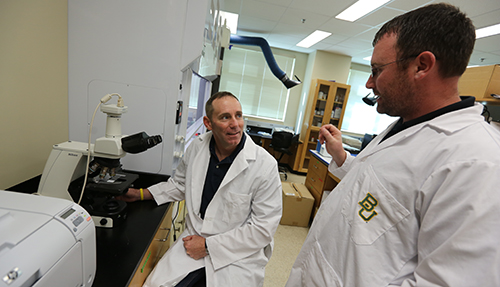
A chance conversation between two Baylor professors while walking across campus has led to new insights on how pollutants and other man-made stressors impact marine animals.
While strolling across the Baylor campus to get coffee, Dr. Stephen Trumble, an assistant professor of biology, was describing to his colleague how biologists use the layers in a whale’s earwax to age a whale (similar to how tree rings reveal age). Dr. Sascha Usenko, an assistant professor of environmental science, had been using sediment cores to study pollution in U.S. national parks. His ears perked up; could the whale earplugs provide similar data for the oceans?
Over the past two years, Trumble and Usenko have sought to answer that question. Their finding: A very resounding “yes.” The plugs of earwax — built up over a whale’s entire life — allowed the scientists to, for the first time, reconstruct the contaminants encountered by the animal. Specifically, the pair found mercury as well as organic contaminants such as pesticides and flame retardants in the first sample they studied, demonstrating that both man-made and endogenous chemicals are recorded and archived in whale earwax.
[WATCH video of how Trumble and Usenko study the earwax.]
Last week, the Baylor pair’s research findings were published in the Proceedings of the National Academy of Sciences of the United States of America. Since then, the results have been picked up by dozens of news outlets: Nature, National Geographic, Smithsonian, Wired, NPR, NBC, MSN, Yahoo!, and newspapers from Los Angeles to Atlanta.
My favorite? This German Public Radio interview with Trumble. (Seriously – give it a listen.)
Sic ’em, Baylor researchers!